
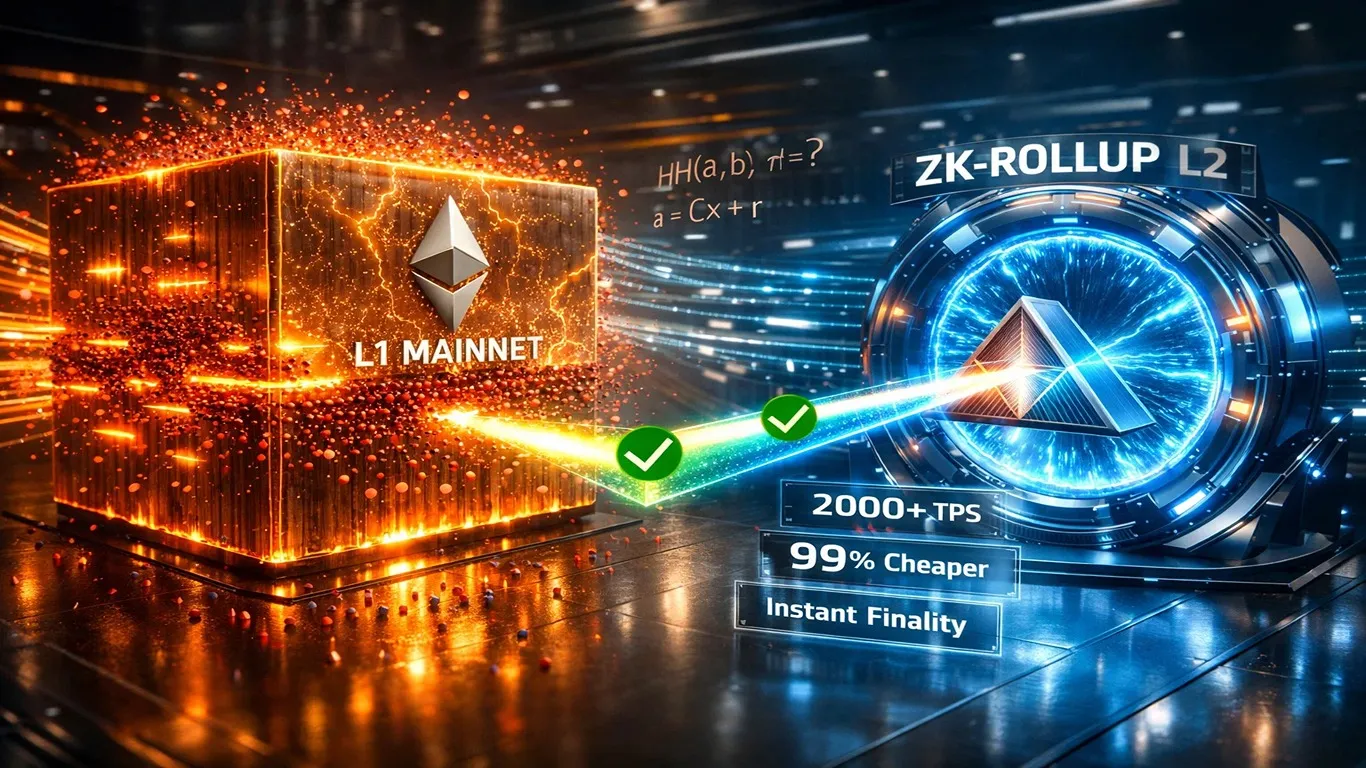
Zero-knowledge rollups, or ZK-rollups, are layer-2 scaling solutions that process blockchain transactions off-chain and submit cryptographic proofs to the main network.[web:33][web:36] Understanding what are zk-rollups in blockchain helps developers and users grasp how modern scaling works. ZK-rollups bundle hundreds of transactions into a one batch, generate a mathematical proof of validity, and settle the final state on-chain.[web:34][web:39] At Snark Labs, our blockchain development team specializes in zk-rollup development to help dapp development companies and web3 development company clients scale their applications efficiently.
How Do ZK-Rollups Process Transactions Differently?
ZK-rollups operate through a unique off-chain processing model that sets them apart from traditional blockchain systems. Users submit transactions to the rollup, where an operator collects and executes them off-chain.[web:36] The operator then generates a zero-knowledge proof—a cryptographic guarantee that all transactions are valid and correctly computed.[web:33]
This proof gets posted to the Ethereum mainnet along with bundled transaction data. The network verifies the proof mathematically in milliseconds, either accepting or rejecting the entire batch.[web:36] Once verified, all transactions become final immediately without waiting periods.[web:35] This design removes the need to execute transactions on mainnet, drastically reducing computational demands.
What Is Web3 Developer Role In ZK-Rollup Development?
A what is web3 developer question becomes clearer when examining scaling solutions. Web3 developers building with ZK-rollups must understand cryptography, off-chain systems, and proof generation mechanics.[web:34] They work with specialized languages and frameworks designed for zero-knowledge systems.
These developers collaborate on blockchain development projects that require understanding state management, transaction batching, and proof verification.[web:42] They implement smart contracts for rollup systems and design user-facing applications that interact seamlessly with layer-2 solutions.
Why Should Developers Choose ZK-Rollups Over Alternative Solutions?
ZK-rollups offer distinct advantages over other scaling approaches.[web:35] They provide faster finality since transactions become final upon proof verification rather than waiting through dispute periods. They deliver superior security through cryptographic certainty rather than relying on participants to spot fraud.
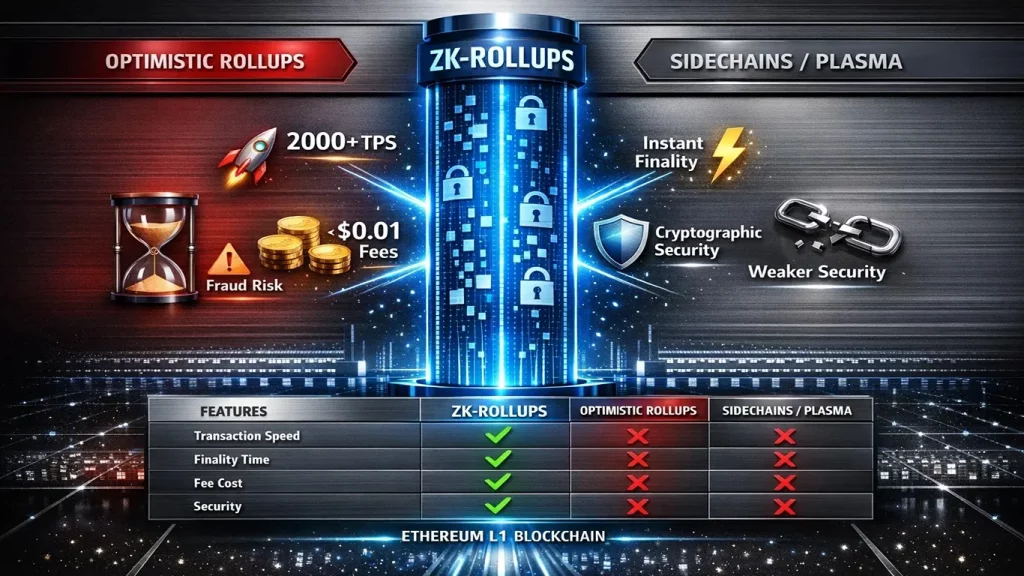
ZK-rollups process thousands of transactions per second, dramatically improving throughput.[web:37] They reduce gas fees by spreading mainnet costs across many smaller transactions, making applications affordable for everyday users.[web:40]
Security is cryptographic rather than dependent on honest network participants. This approach inherits security from layer-1 while adding mathematical certainty.[web:35][web:38]
What Makes ZK-Rollups Different From Optimistic Rollups?
| Aspect | ZK-Rollups | Optimistic Rollups |
| Validation Method | Cryptographic proofs | Fraud challenge period |
| Transaction Finality | Immediate (minutes) | Delayed (7 days) |
| Security Model | Cryptographic certainty | Trust-based verification |
| Data Posted On-Chain | Only validity proofs | Full transaction data |
| Processing Speed | Thousands per second | Slower due to checks |
| Gas Efficiency | Lower per-transaction | Higher per-transaction |
| Implementation Complexity | More complex | Simpler |
Optimistic rollups assume transactions are valid unless proven otherwise. They require a dispute period allowing anyone to challenge batches with fraud proofs.[web:35][web:38] ZK-rollups instead prove validity upfront through cryptography.
Optimistic rollups post entire transaction data on-chain, consuming more space. ZK-rollups post only proof hashes, using far less on-chain data.[web:38] This efficiency difference significantly impacts costs and scalability.
How Does ZK-Rollup Development Impact DApp Development?
ZK-rollup development enables more sophisticated dapp development company projects.[web:34] Gaming platforms benefit from faster, cheaper transactions enabling smooth gameplay. DeFi protocols can handle millions of trades daily without network congestion.
Developers using a mobile app development company building on ZK-rollups access better user experiences through reduced costs and faster settlement. Enterprise applications requiring high throughput gain practical scaling solutions.
What Technical Challenges Exist With ZK-Rollups?
ZK-rollup implementation remains more complex than optimistic approaches.[web:41] Generating zero-knowledge proofs requires significant computational power. This added cost becomes negligible at scale but affects smaller projects.
EVM compatibility presents another challenge. zkEVMs now bridge this gap, allowing developers to deploy existing Solidity contracts with minimal changes.[web:36] As technology matures, these limitations become increasingly irrelevant.
In Summary: What Are ZK-Rollups in Blockchain?
Understanding what are zk-rollups in blockchain reveals powerful scaling solutions for modern applications. They combine cryptographic security with practical performance improvements. If you are discovering blockchain development or working with a web3 development company on zk-rollup development, these solutions address actual scalability challenges facing blockchain networks today. The technology continues advancing speedily, making ZK-rollups progressively accessible and cost effective for developers building the next generation of decentralized applications.