

Consulting and product companies operate on basically different business models. Understanding consulting vs product company distinctions supports entrepreneurs and professionals make knowledgeable decisions about which path aligns with their goals. Consulting companies sell expertise and time to solve client problems. Product companies build and sell software solutions to many customers.
At Snark Labs, we operate as a specialized dapp development company that blends both approaches, delivering consulting expertise with product-level quality. We work with web3 development company clients while providing mobile app development company services and mobile app development tips alongside strategic guidance.
What Exactly Is The Core Difference Between Business Models?
In consulting companies, your time and expertise become the product. Clients pay hourly or project rates for your team’s work solving their specific problems. Revenue scales with headcount. You need more people to make more money. Revenue growth requires hiring consultants.
Product companies create software solutions sold to many customers simultaneously. Revenue comes from subscriptions or licensing fees. One developer can serve thousands of users. Revenue scales with customer adoption, not headcount. Growth depends on product quality and market fit, not hiring speed.
Why Would Companies Choose Consulting vs Product Company Models?
Consulting companies offer several advantages. They provide immediate revenue from day one since clients pay for work completed. You solve real customer problems directly. You gain exposure across industries and technologies. Each project brings different challenges and learning opportunities.
Product companies develop deep expertise in specific domains. They iterate on solutions based on user feedback. They invest in quality because the product represents their brand. Teams stay focused on one problem, allowing architectural depth and mastery.
However, product companies face uncertainty. Early stage products have no guaranteed market. Development requires months or years before revenue appears. Teams must sustain through the building phase without client income.
How Do Revenue And Profitability Models Compare?
Consulting generates immediate cash flow. Project income pays salaries quickly. Profitability comes faster because revenue starts immediately. However, scaling requires proportional hiring increases.
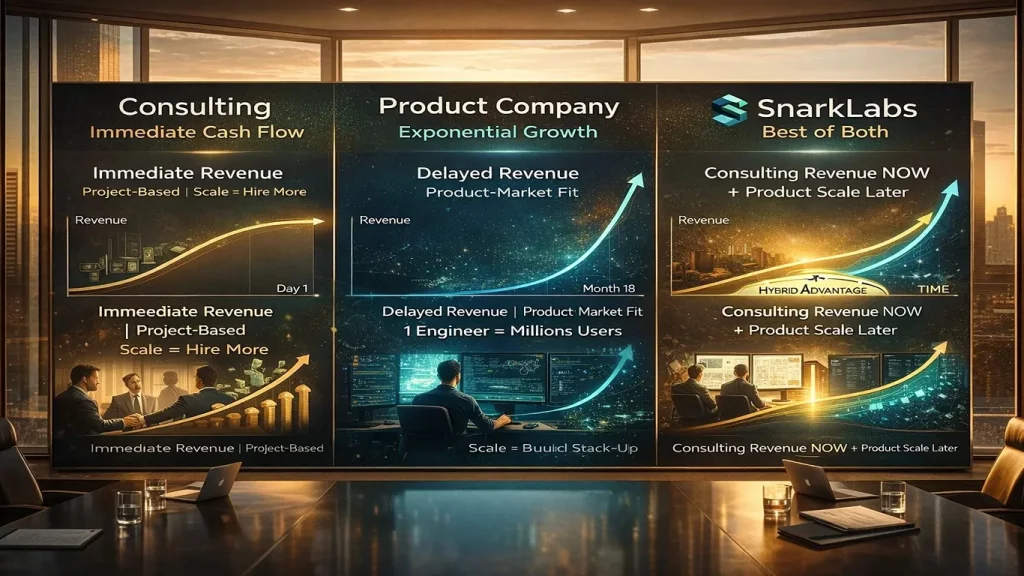
Products take longer to reach profitability. Initial development costs come before customer revenue. However, once product-market fit emerges, growth becomes exponential. One engineer can serve millions of users.
Hybrid models like Snark Labs combine both approaches. We provide dapp development company consulting services while building reusable components and frameworks. This strategy generates immediate consulting revenue while developing longer-term product value.
Consulting vs Product Company: Key Business Metrics
| Revenue Model | Time/expertise-based | Subscription/licensing-based |
| Revenue Timing | Immediate, project-based | Delayed, subscription growth |
| Scaling Method | Hire more consultants | Add more customers |
| Profit Dependency | Billable hours | Customer retention |
| Client Relationships | Direct, ongoing project work | Limited direct interaction |
| Technology Focus | Diverse, client-dependent | Deep specialization |
| Career Development | Broad exposure, varied skills | Deep expertise, specialization |
| Work Variety | High, constantly changing projects | Lower, focused product |
| Job Security | Depends on client contracts | Depends on product demand |
| Innovation Freedom | Limited by client requirements | High, internal-driven |
| Team Mobility | May work at client locations | Centralized, office-based |
What Are The Career Implications For Professionals?
Consulting offers variety and quick skill development. You encounter different technologies, industries, and problem types regularly. Your network expands across multiple organizations. You learn to communicate with diverse stakeholders.
However, consulting demands extensive travel in traditional models. You switch contexts frequently between projects. Depth becomes challenging when jumping between different solutions.
Product roles offer depth and mastery. You become expert in specific technologies and business domains. You see how your code performs at scale. You experience the complete product lifecycle from conception to mature operation.
The tradeoff: product roles provide less variety. Technology choices get established early and remain stable. Learning opportunities narrow to your specific domain.
When Should A Company Choose Each Model?
Choose consulting when you have expertise to sell and understand customer pain points. Consulting works for teams wanting diverse experiences and immediate revenue. It suits professionals who prefer varied work and broad exposure.
Choose products when you identify an underserved market need and have the resources to develop a solution. Products work for teams passionate about specific problems and willing to invest in deep solutions. They suit professionals wanting mastery and long-term impact.
Hybrid models work when you have consulting expertise that reveals product consultant opportunities, or when products generate revenue streams supporting new development.
In Summary: Consulting vs Product Company
Understanding consulting vs product company models clarifies which business approach fits your situation. Consulting generates quick revenue and provides variety. Products create scalable value but require patience and capital. Many successful organizations, including a web3 development company like Snark Labs or any mobile app development company providing mobile app development tips, combine both approaches. The best choice depends on your expertise, capital availability, market understanding, and personal preference for depth versus breadth. Both paths create value they simply create it differently.